📈 Company Highlights
The following stocks follow a Growth-Value-Dividend (GVD) approach towards a well-balanced and diversified equity position:

Advanced Micro Devices, Inc. (NASDAQ:AMD)
Sector: Technology
Industry: Semiconductors
🔥 Expecting 2X by 02/2027. Enjoy the ride!
This financial victory coincides with AMD joining the exclusive $1 trillion market cap club, a milestone attributed to CEO Lisa Su’s legendary turnaround of the once-struggling company—a feat directly comparable to Steve Jobs saving Apple beginning in 1997. Fueled by a 107% year-over-year increase in AI-driven data center sales, AMD’s stock has surged recently. Although AMD still trails industry leader Nvidia, the company is perfectly positioned to capture significant market share, disrupt Nvidia’s margins, and ultimately achieve a faster revenue growth rate than its dominant rival in the coming years.

American Express Company (NYSE:AXP)
Sector: Financial Services
Industry: Credit Services / Financial Processing

Celsius Holdings, Inc. (NASDAQ:CELH)
Sector: Consumer Defensive / Consumer Staples
Industry: Beverages - Non-Alcoholic
🎯 Price Target: $100+
Recent Nielsen data for Celsius Holdings reveals a nuanced narrative: hyper-growth from Alani Nu is currently offsetting a 20% volume pullback in the core Celsius brand, which faces near-term retail headwinds from viral, transient competitors like Bloom Energy. Drawing historical parallels to Monster Beverage's multi-year growth decelerations, temporary volume slowdowns and SKU rationalization are common hurdles for category leaders and do not diminish long-term brand equity among loyal adult consumers. Consequently, the investment thesis rests on the core Celsius brand hitting an inflection point and returning to positive volume growth—a catalyst likely to spark a sharp, pre-emptive stock re-rating well before it shows up in headline quarterly earnings, (October 2026).

e.l.f. Beauty, Inc. (NYSE:ELF)
Sector: Consumer Discretionary
Industry: Cosmetics & Personal Care

Meta Platforms, Inc. (NASDAQ:META)
Sector: Technology Services (Communication Services under GICS)
Industry: Internet Software/Services / Interactive Media & Services
Netflix, Inc. (NASDAQ:NFLX)
Sector: Communication Services
Industry: Entertainment
Nike, Inc. (NYSE:NKE)
Sector: Consumer Discretionary (Consumer Cyclical)
Industry: Apparel, Accessories, and Footwear

RH (formerly Restoration Hardware) (NYSE:RH)
Sector: Consumer Cyclical sector (also referred to as Consumer Discretionary)
Industry: Specialty Retail
🎯 Price Target: At least 3X. Buy ASAP.
Salesforce, Inc. (NASDAQ:CRM)
Sector: Technology
Industry: Software - Application
ServiceNow, Inc. (NASDAQ:NOW)
Sector: Technology
Industry: Software - Application (or Systems Software)

SoFi Technologies, Inc. (NASDAQ:SOFI)
Sector: Financial Services
Industry: Credit Services / Fintech
🎯 Price Target: At least $50-100 long term.
Wynn Resorts, Limited (NASDAQ:WYNN)
Sector: Consumer Discretionary
Industry: Hotels, Restaurants & Leisure (Casinos & Gaming)
🏢 Sectors
There are 11 official stock market sectors defined by the Global Industry Classification Standard (GICS).

Communication Services: Companies that facilitate communication and offer digital entertainment, content, and services.

Consumer Discretionary: Businesses selling non-essential goods and services purchased via extra disposable income.

Consumer Staples: Essential products people need regardless of their financial health, (groceries, hygiene items, etc.)

Energy: Businesses involved in finding, producing, refining, and transporting oil, gas, and renewable energy options.

Financials: Banks, investment funds, insurance companies, and financial firms that manage money and assets.

Health Care: Medical providers, pharmaceutical makers, biotechnology researchers, etc.

Industrials: Heavy machinery, aerospace, defense, manufacturing, and transport services like airlines and railroads.

Information Tech: Tech innovators focused on software development, computer hardware, semiconductors, and IT services.

Materials: Chemical producers, metal refiners, forestry products, and raw material suppliers used in manufacturing.

Real Estate: Property developers, management companies, and real estate investment trusts (REITs).

Utilities: Essential public service providers delivering electricity, natural gas, water, and waste management.
🎉 Top Ten Stocks
The following represents an aggressively scaled portfolio of growth stocks, where percentages represent current proportions of allocated shares.
Units in billions. Updated on 10-08-26.
2026-10-23 (Friday)
🌎 Global Economic Headlines
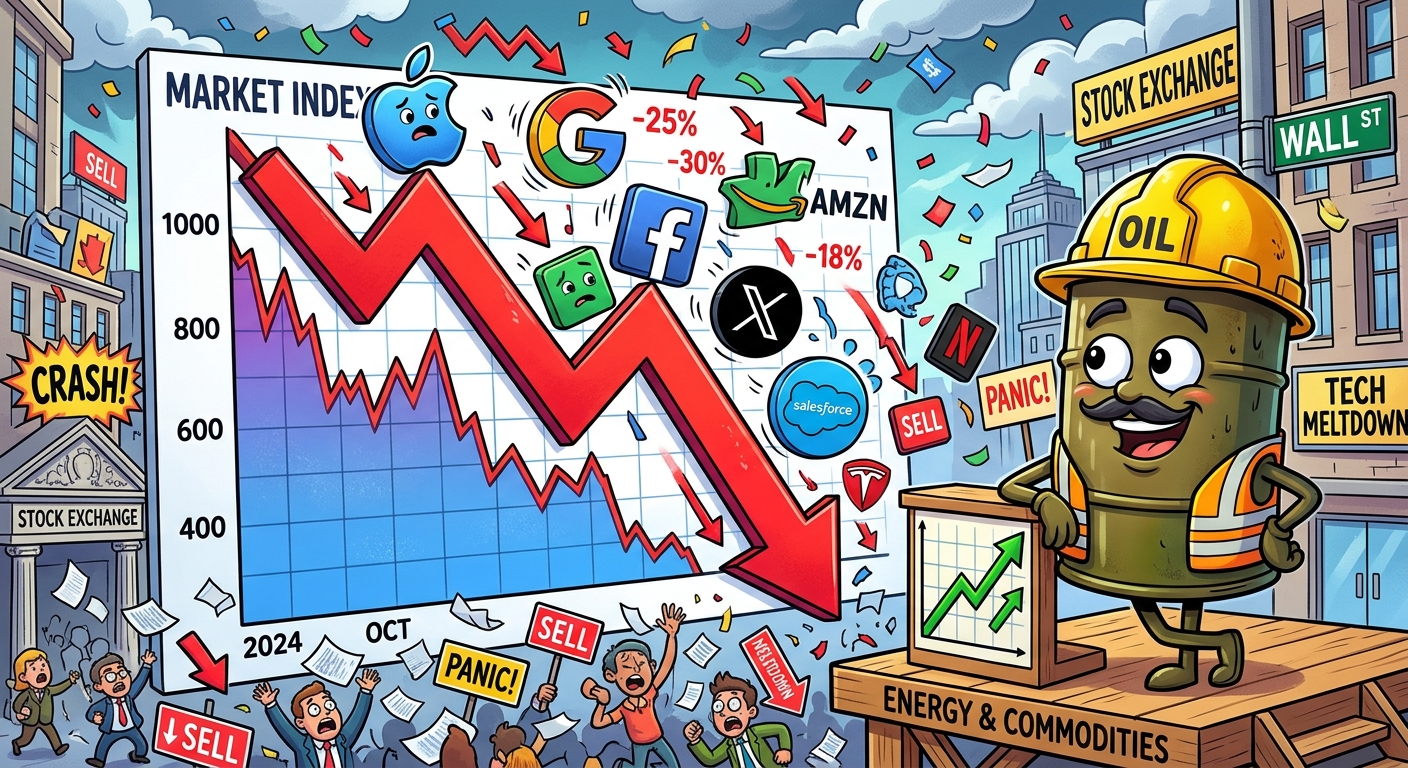
On October 23, 2026, global financial markets faced downward pressure as a sharp tech and artificial intelligence sell-off swept across Wall Street and international exchanges, compounding investor anxieties over high capital expenditures and profitability. Simultaneously, Brent crude oil prices surged to a five-month high above $115 a barrel, driven by escalating geopolitical tensions in the Middle East and ongoing supply risks, which collectively fanned renewed inflation fears and pushed investors toward more cautious stances.
2026-10-22 (Thursday)
🌎 Global Economic Headlines
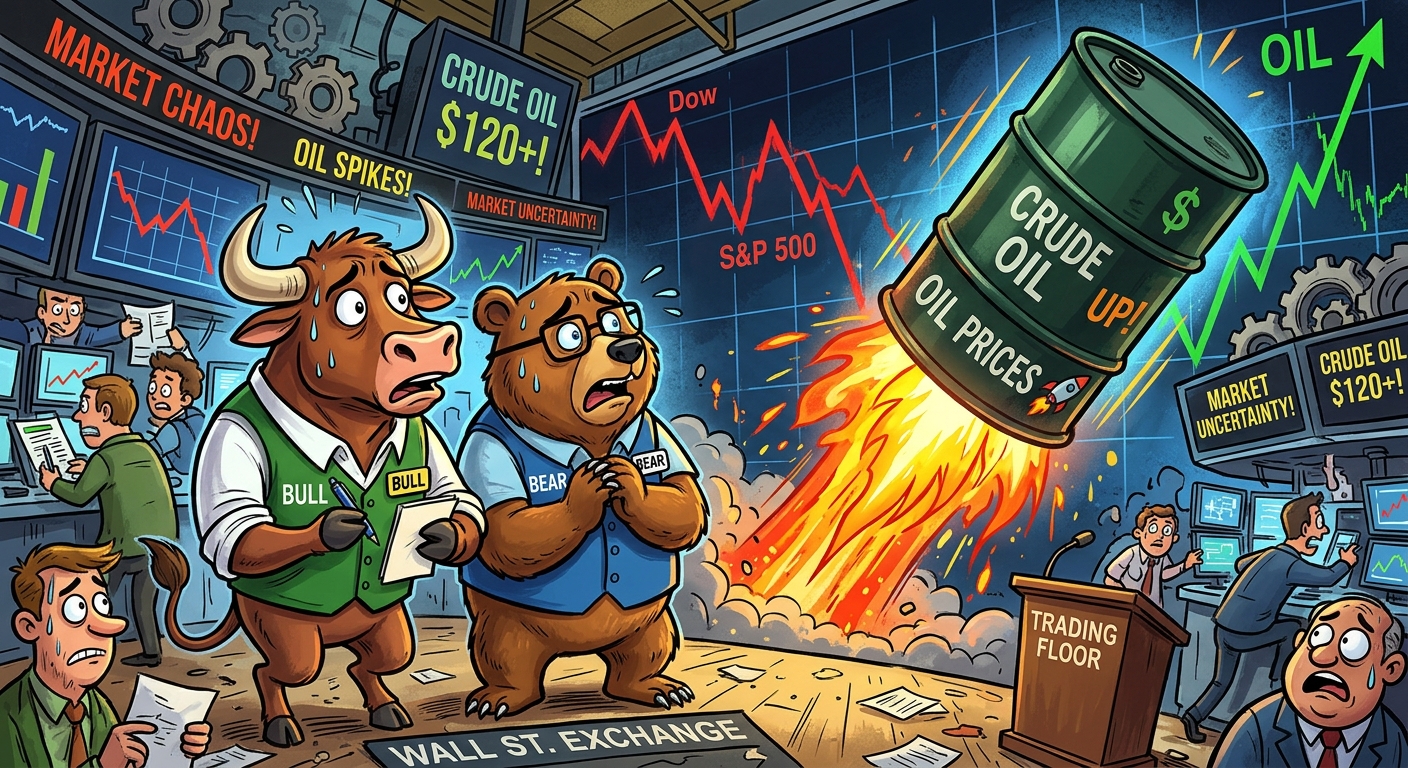
On October 22, 2026, global financial markets tumbled as surging geopolitical tensions in the Middle East drove oil prices to a five-month high, pushing Brent crude above $112 per barrel and sparking a sell-off in equities across Wall Street, Europe, and Asia. Major U.S. stock index futures dropped sharply—with the Dow and S&P 500 sliding alongside a tech-sector retreat—while U.S. Treasury bond yields simultaneously receded as investors sought safe-haven assets. Amidst the broader market volatility, domestic economic data offered a mixed picture, showing initial jobless claims dipping to their lowest level since July alongside a flat Leading Economic Index.
2026-10-21 (Wednesday)
🌎 Global Economic Headlines

On October 21, 2026, global financial markets and economic updates were shaped by tightening monetary policy expectations and mixed sectoral indicators, as U.S. pending home sales declined sharply due to persistent high borrowing costs. Internationally, Japan posted its thirteenth straight month of rising exports fueled by strong semiconductor and tech demand, while central bankers in Australia warned that sticky inflation pressures could necessitate further rate hikes. Amidst these macro trends, investors parsed early third-quarter corporate earnings reports from major firms like AT&T and evaluated tech sector valuations as markets prepared for upcoming Federal Reserve policy decisions.
2026-10-20 (Tuesday)
🌎 Global Economic Headlines
On October 20, global markets experienced a cautious shift as investors weighed volatile oil prices, elevated inflation signals, and corporate earnings headwinds. U.S. stock futures slipped under the pressure of a recurring tech sell-off and lowered full-year profit projections from major corporations like General Motors, while European and Asian equities dipped amid rising energy costs and regional labor market disruptions. Meanwhile, central bank policy expectations remained tight as sticky core inflation metrics continued to keep potential interest rate increases firmly in play, (Source: BNN Bloomberg).
2026-10-19 (Monday)
🌎 Global Economic Headlines
On October 19, 2026, global financial markets displayed mixed trends as Wall Street experienced a tech-led rebound fueled by artificial intelligence shares recovering from prior sell-offs, while European indices slipped amid regional protests and ticking bond yields. Investors are currently weighing short-term Treasury auctions and housing market indicators against a busy upcoming week of high-profile corporate earnings reports from major companies like Tesla, Meta, and Netflix.
😉 Moral of the Story: A Fairly Priced Market
One can address the perennial debate over whether the stock market is cheap or expensive by contrasting traditional valuation metrics—such as the historically high Schiller PE and trailing P/E ratios—with the unprecedented fundamentals of today's market leaders. While these classic indicators mirror levels seen during the dot-com bubble, direct comparisons fall short because modern tech giants operate in a completely new economic paradigm. Driven by global scalability, lower employee overhead, and technological innovation, companies like Nvidia, Microsoft, and Palantir are achieving staggering net profit margins of 40% to 60% alongside robust double-digit revenue growth.
Looking ahead, while massive hardware depreciation from AI semiconductor investments will introduce non-cash expenses on future earnings statements, forward P/E ratios suggest the market is fairly valued rather than trapped in a dangerous bubble. Attempting to time the market or sitting on cash out of fear of high valuations causes investors to miss historic long-term gains. Instead, the key to success is tuning out short-term market noise, doing rigorous fundamental research, and maintaining consistent investments through every market cycle, regardless of temporary volatility.
Source: Financial Education
2026-10-16 (Friday)
🌎 Global Economic Headlines
On October 16, 2026, U.S. stock markets traded mixed as Wall Street worked to recover from a recent tech sector pullback, with investors closely scrutinizing whether massive corporate investments in artificial intelligence are translating into adequate revenue. This cautious sentiment follows the Federal Reserve’s latest Beige Book release highlighting slight-to-moderate economic growth and persistent input price pressures, keeping market participants deeply focused on upcoming corporate earnings, inflation metrics, and the future path of interest rates,
(Source: The Street).
💲 Personal Finance Weekly Updates
Whether you are balancing day-to-day spending, organizing a project budget, or building long-term equity, foundational money habits keep your financial foundation solid. Here are five core personal finance principles to put into practice:
1. Automate "Paying Yourself First"
Before allocating funds toward discretionary expenses, automatically direct a set percentage of your income straight into high-yield savings or investment accounts. Treating savings as a non-negotiable fixed expense ensures consistent wealth accumulation without relying on leftover funds at the end of the month.
2. Follow the 50/30/20 Framework
Use a balanced budgeting framework to keep cash flow clear and predictable:
50% Needs: Essential obligations such as housing, utilities, transportation, and groceries.
30% Wants: Flexible spending including dining out, entertainment, and personal hobbies.
20% Savings & Debt Repayment: Future goals, emergency fund contributions, and debt payoff beyond minimums.
3. Maintain a Tiered Liquidity Cushion
Structure your emergency reserves to balance immediate access with interest growth:
Tier 1 (Immediate): Keep 1 month of living expenses in a liquid checking or standard savings account for unexpected immediate costs.
Tier 2 (Core Buffer): Keep 3 to 6 months of expenses in a high-yield savings account (HYSA) or money market fund to combat inflation while maintaining security.
4. Separate Fixed vs. Variable Cash Flow
Track recurring fixed subscriptions and variable daily choices separately. Audit monthly recurring charges periodically to eliminate unused services, and establish clear spending caps on variable categories to prevent passive budget leaks.
5. Focus on Compound Growth over Timing
Long-term wealth building relies more on time in the market than timing the market. Consistently contributing to low-cost index funds or tax-advantaged accounts (like IRAs or 401(k)s) harnesses the power of compound interest while minimizing unnecessary fees.
2026-10-15 (Thursday)
🌎 Global Economic Headlines
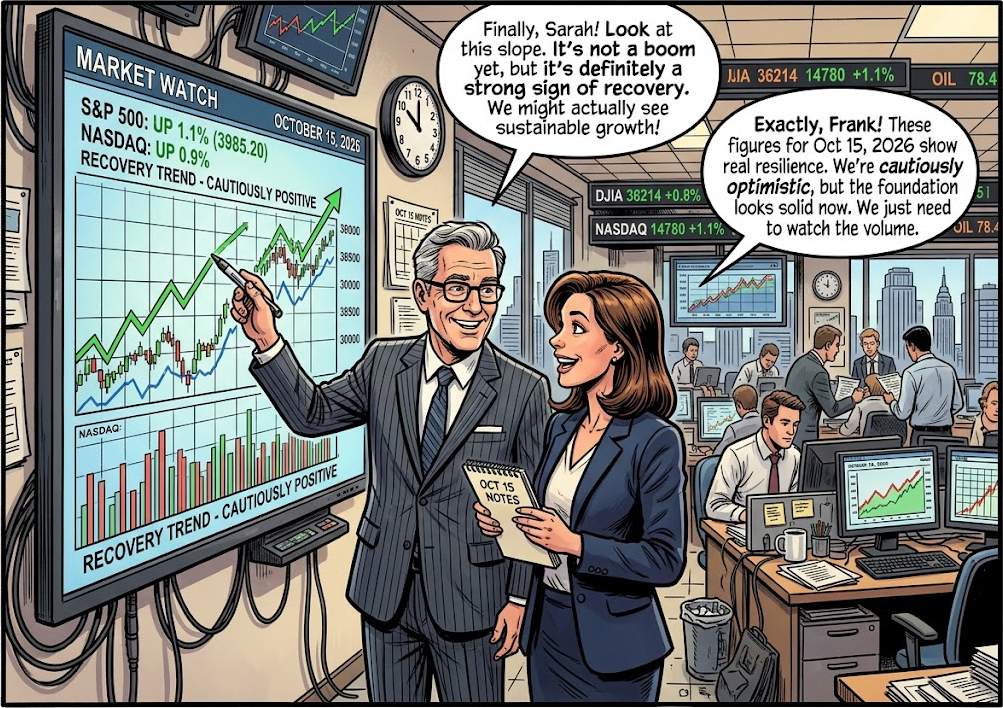
On October 15, 2026, financial markets exhibited a mixed performance as Wall Street attempted to recover from a losing session driven by hotter-than-expected inflation data that sparked a global tech sell-off, while the Dow Jones Industrial Average managed to edge higher due to steady gains in consumer stocks, financials, and healthcare, reflecting an overall resilient yet cautious economic environment, (Source: The Street).
The global and domestic economic landscape is defined by mixed signals: while fresh data indicates a stabilizing labor market following a steady rebound in spring and summer hiring, lingering inflationary pressures—evidenced by higher-than-expected CPI numbers driven by gas, energy, and airfares—continue to complicate the rate outlook. Globally, the IMF recently upgraded its growth forecast for the year to 3.2%, though it warned of ongoing fiscal vulnerabilities, including high public debt levels and high real bond yields impacting international credit markets. Meanwhile, markets and policymakers remain closely tuned to upcoming Federal Reserve commentary and key regional indexes, balancing steady labor participation against persistent price challenges ahead of the final quarter, (Source: Federal Reserve Bank of Atlanta).
😉 Moral of the Story: Warning Signs before a Market Crash
Absence of Corporate Mergers, Acquisitions, and IPOs: A complete freeze in major corporate deal-making and a lack of initial public offerings signal a severe contraction in market confidence, as institutional players and private equity pull back from high-risk liquidity events.
Dry Up of Venture Capital and New Money: A drastic reduction in fresh capital flowing into early-stage ventures and startups demonstrates that risk appetite has evaporated among institutional investors, mimicking historical market tops.
Distorted and Overextended Valuations: Pervasive pricing disconnects—manifested through unsustainably high price-to-sales and EV/EBITDA multiples—reveal that speculative frenzy has completely detached asset prices from underlying economic fundamentals.
Widespread Euphoria and Retail Complacency: Extreme bullish sentiment paired with a pervasive "buy the dip" mentality among everyday investors indicates that market participants are blind to systemic risks right before a correction.
Macroeconomic Divergences and Tightening Conditions: A disconnect between surging equity markets and underlying macroeconomic deterioration—such as tightening liquidity, rising debt burdens, and slowing consumer spending—creates an inherently fragile environment prone to sudden, severe unwinding.
Source: 1000XStocks
2026-10-14 (Wednesday)
🌎 Global Economic Headlines
On October 14, 2026, U.S. stocks traded lower as investors digested a hotter-than-expected inflation update, with the September Consumer Price Index (CPI) showing annual inflation accelerating to 3.7%—largely driven by rising energy and shelter costs. The core CPI, which excludes food and energy, rose 0.3% for the month and 2.6% year-over-year, dampening Wall Street's expectations for aggressive Federal Reserve interest rate cuts in the coming months. Concurrently, the federal government officially announced a ~3.5% Cost-of-Living Adjustment (COLA) for 2027 Social Security benefits based on the latest inflation metrics, while energy prices pushed higher as benchmark crude oil gained following elevated geopolitical tensions.
2026-10-13 (Tuesday)
🌎 Global Economic Headlines
On October 13, 2026, global financial markets kicked off the unofficial start of third-quarter earnings season with mixed results from major banking institutions—JPMorgan Chase and Wells Fargo posted light revenues, while Goldman Sachs surged on strong quarterly results—as tech and semiconductor equities faced continuing pressure. Investors held a cautious stance ahead of the upcoming Consumer Price Index (CPI) inflation report, while Treasury yields and crude oil prices ticked lower following remarks from Federal Reserve Governor Christopher Waller suggesting elevated yields are effectively cooling demand in interest-rate-sensitive sectors. Meanwhile, fresh regional labor market analyses indicated modest, broader-based job growth stabilizing across non-healthcare sectors, even as macro headwinds like international energy market volatility continue to draw close attention.
2026-10-12 (Monday)
🌎 Global Economic Headlines
On October 12, 2026, the global economic spotlight focused on the announcement of the 2026 Nobel Memorial Prize in Economic Sciences, awarded to American economists Robert E. Hall and Michael Woodford for their foundational research on managing macroeconomic fluctuations and boom-bust cycles. Meanwhile, commodity markets saw Brent crude oil futures jump to a two-week high driven by heightened global supply risks and ongoing energy market shifts, while global markets braced for upcoming consumer price index releases and Federal Reserve commentary scheduled throughout the week to gauge the trajectory of inflation and central bank monetary policy.
2026-10-09 (Friday)
🌎 Global Economic Headlines
U.S. markets traded with cautious optimism on October 9, 2026, as equities edged higher despite preliminary survey data showing a further deterioration in consumer sentiment and elevated near-term inflation expectations hovering around 3.5%. The Federal Reserve released its latest Survey of Consumer Finances offering fresh insight into American family balance sheets, while investors closely monitored ongoing political scrutiny surrounding central bank governance and rate expectations. Meanwhile, commodity markets digested the USDA's monthly WASDE report—which bumped corn yield projections up to 181.2 bushels per acre—alongside a modest decline in crude oil prices that helped temper immediate energy market concerns.
💲 Personal Finance Weekly Updates
As Q4 gets underway this October, focus on three high-impact moves: build a firm holiday spending plan before seasonal impulse buys hit, evaluate your open enrollment options for 2027 (optimizing health coverage and FSA/HSA contributions), and audit your retirement contribution pacing so you can max out your 401(k) or IRA by December 31. Taking time now to set strict holiday caps, secure all employer matches, and review potential tax-loss harvesting candidates will prevent end-of-year financial stress and set up a clean, strong momentum heading into the new year.
2026-10-08 (Thursday)
🌎 Global Economic Headlines
U.S. stock futures traded lower on October 8 as market volatility persisted, driven by rising U.S. Treasury yields and fluctuating crude oil prices amid renewed geopolitical tension and energy supply concerns in the Middle East. Investors are closely digesting the latest Federal Reserve meeting minutes while awaiting weekly jobless claims data and scheduled speeches from Fed officials to gauge the future path of interest rates. Meanwhile, safe-haven assets saw subtle movement with spot gold holding near $4,148 per troy ounce, as broader financial markets balance monetary policy uncertainties with third-quarter corporate earnings releases.
😉 Moral of the Story: The State of the AI Trade
Credit markets are signaling severe anxiety over the aggressive borrowing used to fund AI infrastructure, with the cost to insure tech debt hitting alarming levels. Oracle's credit default swap (CDS) spreads have surged past 200 basis points—surpassing their peak during the 2008 global financial crisis—as the company balances over $100 billion in debt against lagging cash flow. This imbalance recently triggered an S&P downgrade to BBB-, leaving Oracle just one notch above junk status and threatening its position in investment-grade bond indexes. Similar fears are spilling over to SpaceX, whose own CDS spreads nearly doubled following reports of a planned $40 billion debt raise to purchase Nvidia AI chips, proving that even industry darlings are facing intense borrowing scrutiny.
Adding to the sector's headwinds is a growing controversy over how foundational AI companies report their earnings, sparked by reports that OpenAI's annualized revenue came in $20 billion lighter than previously expected. This massive discrepancy stems from diverging GAAP accounting methods: while OpenAI records only its net share of cloud partner sales, rivals like Anthropic record the full, gross transaction amount as top-line revenue before expensing the partner's cut. This gross-revenue accounting tactic artificially inflates top-line numbers, casting doubt on the true financial health and cash-generation capabilities of the industry just as these major players approach highly anticipated initial public offerings.
These debt and revenue vulnerabilities pose a cascading threat to the broader AI trade, particularly for hardware manufacturers. If lower IPO valuations limit the capital these AI pioneers can raise, their future infrastructure spending on chips from companies like Nvidia and AMD will inevitably shrink. Consequently, investing solely on the premise of an "AI trade" has become highly dangerous given the murky revenue quality and circular flow of capital across the sector. The safest investment approach right now avoids pure-play AI hype in favor of companies with robust, established core businesses—like Meta and Amazon—where AI serves as a powerful growth accelerator rather than the singular pillar holding up the stock.
😉 Moral of the Story: The Downside of Treasury Bonds
Attempting to predict short- to medium-term Treasury bond yields is a futile and unprofitable endeavor, primarily because macroeconomic interest rates are fundamentally unpredictable—even for the Federal Reserve itself. While investors can reliably forecast corporate earnings for fundamentally strong companies over a multi-year horizon, guessing whether a 10-year Treasury will hit 4% or 6% amounts to nothing more than a blind gamble, regardless of how closely one monitors financial news. Ultimately, obsessing over minor fluctuations in bond yields is a distraction from true wealth creation; the real financial upside in investing is generated not by timing the macroeconomic bond market, but by researching, identifying, and holding transformative, high-growth individual stocks through inevitable market cycles.
2026-10-07 (Wednesday)
🌎 Global Economic Headlines
U.S. stock markets traded moderately lower on Wednesday, October 7, as elevated Treasury bond yields continued to weigh on investor sentiment and broader market breadth. The major indexes pulled back slightly—led by small-cap equities—as market participants monitored pressure on real borrowing costs and high mortgage rates. Investors remained cautious while awaiting the release of the Federal Reserve’s latest meeting minutes for further guidance on the central bank’s upcoming interest rate trajectory, amid expectations that policymakers will favor a cautious approach.
The market backdrop follows fresh economic reads indicating that the domestic economy maintains resilient underlying momentum, particularly in the services sector, where expansion sits near multi-year highs. However, business surveys also highlight intensifying input cost pressures driven by elevated energy and labor costs, keeping inflation dynamics and fiscal debt issuance central to investor concerns as the fourth-quarter earnings season approaches.
😉 Moral of the Story: How to Buy a Stock
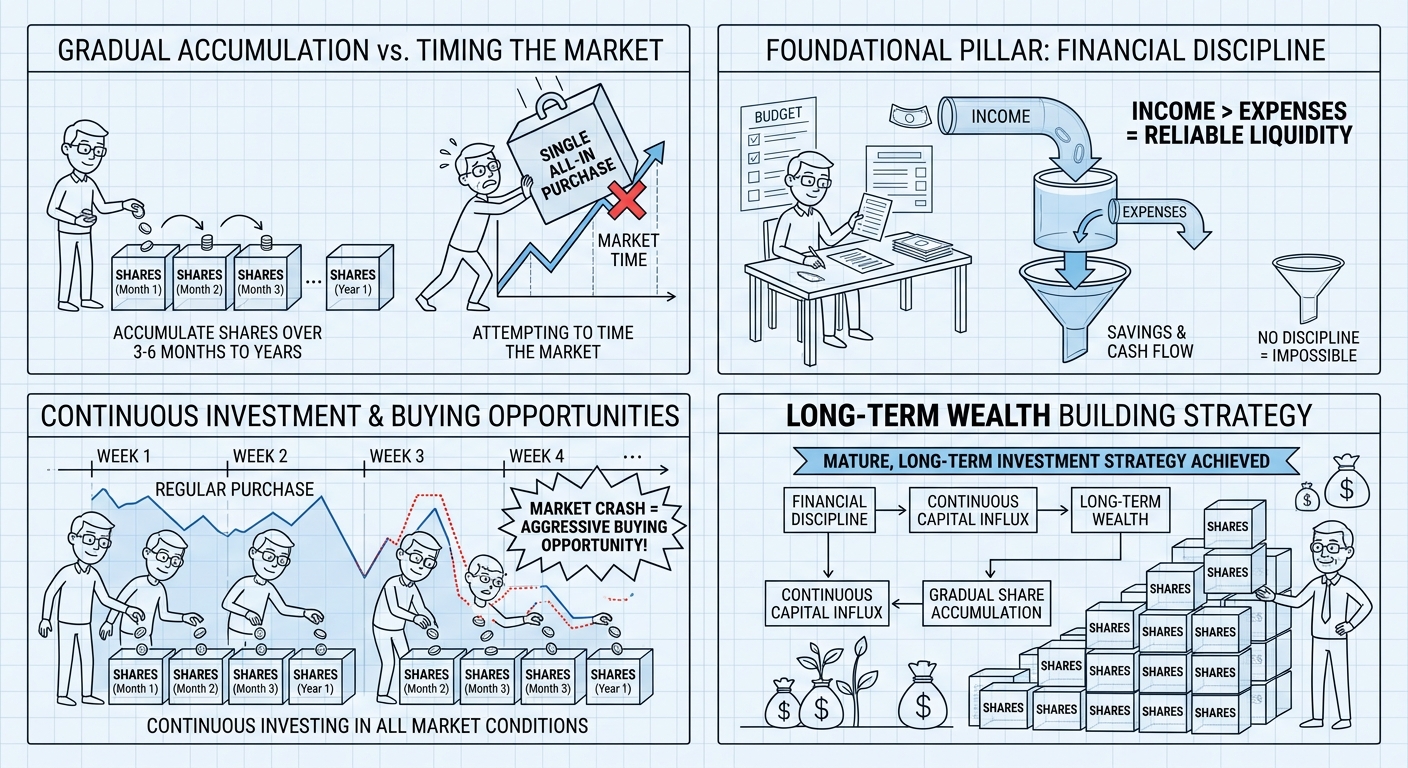
A mature, long-term investment strategy is built on the gradual accumulation of shares rather than attempting to time the market with a single, all-in purchase. One approach is to gradually build a position over a three- to six-month timeframe, occasionally extending to several years, allowing the investor to buy in at various price points of each stock.
The foundational pillar of this approach is maintaining a consistent financial surplus by ensuring income always exceeds expenses. This reliable cash flow provides the liquidity needed to invest continuously, often on a weekly basis, allowing the investor to view market crashes and sector corrections as aggressive buying opportunities rather than moments of panic. Without this personal financial discipline and a continuous influx of investable capital, executing a long-term wealth-building strategy remains impossible.
2026-10-06 (Tuesday)
🌎 Global Economic Headlines
The U.S. Bureau of Economic Analysis and Census Bureau released August trade data showing the U.S. international trade deficit in goods and services widened by 13.7% to $105.6 billion. The expanding gap was driven by a 4.1% increase in real imports of goods to $342.2 billion, outstripping a 1.4% gain in exports to $315.2 billion. Despite widening trade balances and persistent input costs across the services sector, underlying consumer sentiment showed mild resilience: the RealClearMarkets/TIPP Economic Optimism Index for October rose unexpectedly to 46.8 from 45.6 in September, reflecting slight gains in personal financial expectations and federal policy outlooks.
Financial markets traded higher, building on tech-led momentum that propelled the Nasdaq Composite to fresh record highs. Equity markets found support in a slight pullback in global crude oil prices, which temporarily eased energy-driven inflation concerns following recent geopolitical friction. However, elevated long-term Treasury yields and expanding fiscal deficits continue to weigh on borrowing costs. Investors are closely monitoring upcoming Federal Reserve speaker remarks and September meeting minutes for clues on whether the central bank will pause or pursue further interest rate adjustments later this autumn.
😉 Moral of the Story: Housing and the Economic Cycle
The housing market is the central engine of the US economy, questioning the Federal Reserve's need for aggressive rate hikes given the current economic slowdown. Right now, the housing sector is essentially "dead," with drastic declines across new builds, multifamily units, single-family homes, and existing home sales. Because a thriving real estate market directly fuels broader economic growth, thawing this frozen market is the key to bringing the overall economy back to full strength.
To illustrate how housing drives economic health, observe the massive ripple effect of home construction and renovation. Building or upgrading a home employs a wide array of tradespeople—from plumbers and electricians to roofers and landscapers—who then inject their earnings back into the local economy. When people stop buying and improving homes, this critical cycle of job creation and consumer spending grinds to a halt.
2026-10-05 (Monday)
🌎 Global Economic Headlines
The U.S. labor market enters October 2026 under growing pressure following a sharp drop in monthly hiring. Employers added just 29,000 jobs in September, triggering a slight rise in unemployment and signaling a broader cooling across the economy. The weaker jobs data has sharply shifted expectations for monetary policy, with futures markets pricing in an over 80% likelihood that the Federal Reserve will hold interest rates steady at its upcoming meeting as policymakers weigh slowing economic growth against sticky consumer inflation expectations.
Simultaneously, elevated borrowing costs and persistent energy volatility continue to squeeze both corporate operations and households. Long-term interest rates remain near multi-year highs—with benchmark 30-year mortgage rates climbing to 7.28% and 5-year Treasury yields pushing up corporate capital costs. Compounding these monetary headwinds, volatile energy prices and diesel supply constraints have prompted G7 nations to coordinate emergency reserve releases in an effort to cushion consumer spending and ease inflationary pressures.
2026-10-02 (Friday)
🌎 Global Economic Headlines
The U.S. labor market slowed sharply in September, with employers adding just 29,000 jobs as the unemployment rate ticked up to 4.2%. Meanwhile, energy markets remain under scrutiny as global supply pressures prompt discussions around emergency fuel reserves.
💲 Personal Finance Weekly Updates
As October 2 marks the official start of the fourth quarter, the single most impactful move is auditing your year-to-date savings pacing across tax-advantaged accounts like your 401(k), IRA, and HSA. With roughly six to seven paychecks remaining in 2026, now is the time to calculate whether you need a temporary contribution increase to hit your annual limits before December 31, rather than attempting a last-minute adjustment in late December. October is also the ideal window for proactive tax optimization: review taxable brokerage accounts for tax-loss harvesting opportunities to offset realized capital gains, check for uninvested cash sitting in IRAs, and model potential Roth conversions while your full-year income picture is clear but actionable.
Beyond retirement accounts, October serves as the financial bridge between employer open enrollment and year-end cash flow management. Treat upcoming health benefit decisions as a core component of your budget, ensuring your Flexible Spending Account (FSA) elections and Health Savings Account (HSA) contributions align with anticipated medical needs and long-term savings goals. Simultaneously, set a firm, itemized spending cap for holiday travel and gifting today. Allocating a fixed transfer per remaining pay period now shields your emergency fund and prevents relying on high-interest debt as year-end expenses ramp up.
2026-10-01 (Thursday)
🌎 Global Economic Headlines
Today’s major U.S. economic releases focus on key manufacturing and labor market indicators, including weekly initial jobless claims, the September ISM Manufacturing PMI, and August construction spending ahead of Friday's monthly jobs report. Globally, international trade opened October on a high note, led by South Korea reporting record monthly exports driven by surging AI semiconductor demand.
😉 Moral of the Story: Current threats to the stock market
The stock market can crash due to two primary catalysts: major economic recessions that force interest rates to near zero, or excessively high Treasury yields. While investors typically associate crashes with severe recessions—like the 2008 financial crisis or the COVID-19 pandemic—a spike in Treasury yields can be equally destructive. If yields approach 7% or 8%, they begin to rival the 8% historical average return of the S&P 500. This guaranteed, risk-free return incentivizes investors to abandon equities, triggering a massive market sell-off.
Despite the severe damage caused by a yield-driven crash, it can create generational buying opportunities. A mass exodus from the stock market aggressively suppresses prices, allowing investors to purchase shares of fundamentally strong companies at extreme discounts. During a true crash (using Nike as an example), stock prices can revert to levels from over a decade ago, presenting rare entry points that effectively ignore years of inflation and corporate growth.
2026-09-30 (Wednesday)
🌎 Global Economic Headlines
Economic attention today is focused on major macro data releases, including August Personal Consumption Expenditures (PCE) inflation figures, ADP payroll stats, and updated second-quarter GDP results. Investors and policymakers are tracking whether persistent price pressures and resilient economic momentum will influence the Federal Reserve's rate strategy heading into the fourth quarter.
😉 Moral of the Story: Semiconductor analysis
The semiconductor sector is currently experiencing an unprecedented bull cycle, with six of the top 16 market caps in the world being direct semiconductor plays alongside major tech buyers developing custom chips. Despite extraordinary quarterly results from memory giant Micron—where revenue jumped 379% year-over-year and gross margin dollars rose 831%—the stock's muted reaction highlights deep market skepticism. Investors view memory and broader hardware spikes as highly cyclical, suspecting that current profit margins and massive tech capital expenditure are approaching a multi-year peak within the next 12 to 24 months. Notable insider share sales, including $130 million by Micron’s CEO and previous heavy selling by Nvidia’s CEO, further underline caution regarding the long-term sustainability of this expansion phase.
Looking beyond the current cycle, AMD emerges as a primary long-term beneficiary within the mega-cap chip landscape. While competitors like Nvidia and TSMC face eventual growth moderation by 2028 as major tech debt loads accumulate and cloud infrastructure spend levels off, AMD's integration of Xilinx positions it uniquely for the subsequent "physical AI" wave—focusing on low-latency computing, edge electronics, and robotics for 2030 and beyond. This broader product tail gives AMD a significantly longer high-growth runway, making it well-positioned to capture incremental capital expenditures and weather future cyclical pullbacks better than peers bound strictly to traditional data center training chips.
Source: Financial Education
2026-09-29 (Tuesday)
🌎 Global Economic Headlines
U.S. stock markets rebounded moderately in early trading today as oil prices cooled and Treasury yields eased slightly from their recent highs. Meanwhile, new economic data showed the labor market continuing to soften, with the latest JOLTS report revealing that August job openings fell to 7.079 million, which was below analysts' expectations.
😉 Moral of the Story: AMD's Strategy Moving Forward
Nvidia recently expanded its share repurchase program by $150 billion, bringing its total buyback authorization to an unprecedented $235 billion over the next 12 to 24 months. To put this in perspective, $235 billion was comparable to the entire market capitalization of the world's top companies back in 2008. Because Nvidia currently holds roughly $22 billion in cash and cash equivalents, the repurchase plan relies almost entirely on deploying projected operating profits over the next two years. In effect, the massive capital expenditures from tech giants like Meta, Google, Amazon, and Microsoft purchasing Nvidia's AI hardware directly fund this share buyback.
This buyback represents a major capital allocation mistake because CEO Jensen Huang is repurchasing stock at the peak of an unsustainable cycle. Nvidia is currently benefiting from extraordinary net margins exceeding 60% as clients take on debt and spend aggressively to secure chips. However, because semiconductor markets are historically cyclical, a projected demand slowdown around 2028—combined with rising competition—could compress margins and revenues. Rather than repurchasing expensive shares at peak performance (drawing comparisons to past buybacks at RH or Apple's missed acquisition opportunities), Nvidia should build up a cash cushion in Treasuries to execute buybacks during an inevitable down cycle at far lower valuations.
In contrast, AMD is pursuing direct business growth by acquiring World Labs—an AI firm focused on 3D spatial intelligence founded by Dr. Fei-Fei Li—for $8.2 billion in stock. By utilizing equity to acquire next-generation AI talent and tech instead of buying back high-priced shares, AMD CEO Lisa Su is positioning the company to compete in the next technological wave. While Nvidia's massive buyback plan may provide temporary support for its stock price as growth decelerates in late 2027 and 2028, strategic reinvestment into long-term technology is viewed as the superior strategy.
Big Oil
Oil prices are currently the primary driver of stock market direction. When crude prices rise, they fuel inflation fears and push Treasury yields higher. Elevated yields make bonds more attractive relative to equities while raising concerns about corporate debt and potential recession. Because tech sector capital expenditures and semiconductor earnings guidance (such as Micron's) are largely anticipated by the market, fluctuations in oil and bond yields remain the principal unknown variables dictating short-term stock movements.
This upward pressure on bond yields has pushed mortgage rates to 7.5%, with potential momentum toward 8%. The rapid increase is reframing consumer expectations around home borrowing costs. While a 5% mortgage rate was viewed as high when rates were historically anchored in the 2% to 3% range, continuing trends toward 8% mean a return to 5% will eventually be perceived as a strong buying opportunity. Despite the NASDAQ remaining range-bound or "stuck" since May, a volatile or sideways market still offers substantial profit opportunities for disciplined investors. Range-bound markets reward strategic positioning, setting the stage for even larger gains when the next broad market bull run takes off.
Source: Financial Education
2026-09-28 (Monday)
🌎 Global Economic Headlines
On September 28, U.S. stock markets faced downward pressure as rising oil prices reignited inflation concerns, causing major indexes like the S&P 500 and the Dow Jones to dip. Meanwhile, investors are cautiously looking ahead to key economic data releases scheduled for later in the week, including the September jobs report and the Federal Reserve's preferred inflation gauge.
2026-09-25 (Friday)
🌎 Global Economic Headlines
U.S. durable goods orders held flat in August at $338.6 billion, topping expectations of a decline as steady core business spending offset drops in transportation equipment. Meanwhile, the University of Michigan consumer sentiment index fell to a four-month low of 48.1 for September as households cited growing concerns over high prices, rising fuel costs, and renewed trade tensions.
💲 Personal Finance Weekly Updates
Mid-September marks a critical transition point as you head into the final quarter of the year. With the third-quarter estimated tax deadline just passed, now is the ideal time to run a year-to-date checkup on your income, tax withholdings, and retirement contributions. Auditing your 401(k) or IRA progress today ensures you still have three full months—and several remaining pay periods—to adjust your contribution rates and hit annual savings goals before December 31. It is also a smart moment to review and rebalance your investment portfolio if market shifts over the summer pulled your target asset allocation out of alignment.
Looking ahead to the fall, mid-September is the sweet spot to prepare for two major upcoming financial events: open enrollment and holiday spending. Take time now to review your year-to-date medical claims so you can evaluate whether a Flexible Spending Account (FSA), Health Savings Account (HSA), or traditional insurance plan best fits your projected health needs for next year. Concurrently, establish a dedicated holiday sink fund in a high-yield savings account. Mapping out gift budgets, travel costs, and year-end social obligations right now prevents high-interest credit card debt when November and December arrive, allowing you to finish the year on solid financial footing.
2026-09-24 (Thursday)
🌎 Global Economic Headlines
U.S. weekly initial jobless claims dropped to a seasonally adjusted 197,000, beating economist expectations and indicating ongoing labor market stability. Concurrently, August new home sales jumped to an eight-month high of 684,000, even as financial markets closely monitored inflation risks fueled by rising oil and energy prices.
😉 Moral of the Story: Consumer Sentiment and the Growth of Legendary Stocks
Consumer sentiment is fundamentally driven by how the average middle-class household perceives its financial trajectory, purchasing power, and day-to-day affordability, rather than top-line stock market highs alone. During stable economic regimes—such as the decade following the Great Financial Crisis—low inflation, manageable housing costs, and predictable living expenses foster a broad-based "Pop Warner" economy where most participants feel they are gaining ground. When everyday expenses remain controlled, discretionary income expands, fostering a baseline of optimism that encourages individuals to spend, build businesses, and confidently allocate excess capital toward long-term investing.
Conversely, persistent inflation and sudden cost-of-living shocks break this broad economic alignment, shifting the market into a "high school football" dynamic where only a small, highly competitive minority thrives while the wider middle class sits on the sidelines. When consumer sentiment turns negative due to squeezed budgets and elevated prices, retail market participation drops as everyday consumers lose both the capital and the psychological confidence required to invest. For legacy companies built to withstand decades of market cycles, enduring these periods of depressed consumer sentiment requires surviving tight economic conditions and reduced consumer enthusiasm until baseline inflation stabilizes and broad-based economic optimism returns to drive the next multi-year growth cycle.
2026-09-23 (Wednesday)
🌎 Global Economic Headlines
Housing & Mortgages: U.S. mortgage applications dropped 1.5% week-over-week as average 30-year fixed rates vaulted above 7% (reaching 7.12%), driving refinance volume to its lowest level since early 2025.
Growth & Inflation Forecasts: The American Bankers Association’s Economic Advisory Committee released its updated outlook, projecting resilient GDP growth of 2.7% for Q3 while warning that sticky core inflation will likely keep interest rates elevated through year-end.
Markets & Energy: Equities faced pressure while Treasury yields rose, largely driven by climbing crude oil prices and ongoing geopolitical trade focus ahead of high-level bilateral summits.
2026-09-22 (Tuesday)
🌎 Global Economic Headlines
U.S. stock markets paused during early trading following Monday's strong tech-led rally, supported by lower Treasury yields and a continued decline in crude oil prices. Investor sentiment is being driven by easing inflation expectations and hopes for diplomatic progress surrounding global geopolitical tensions, particularly during discussions at the UN General Assembly. On the central bank front, markets are monitoring a busy lineup of Federal Reserve speakers while digesting the Bank of Japan's recent rate hike.
2026-09-21 (Monday)
🌎 Global Economic Digest
The Federal Reserve recently raised the benchmark interest rate by 25 basis points to a range of 3.75%–4.00% to address persistent inflation, even as consumer spending and job growth hold up. With a light domestic data calendar this week, investors are focused on upcoming commentary from a wide slate of Fed officials for signals on future rate decisions. Externally, markets are monitoring energy market volatility from Middle East tensions alongside high-level U.S.–China trade discussions.
😉 Moral of the Story: A New Generation of Stocks
The stock market experiences rapid, dramatic shifts where highly favored stocks can suddenly crash while previously cold or hated companies go on massive runs. Prominent market darlings like Novo Nordisk and Celsius dropped over 70% from their peak valuations, whereas previously lagging stocks like Target roughly doubled off their lows. Defensive safe havens like McDonald's and Walmart, which resisted the severe 2022 tech market crash, eventually entered steep corrections as market leadership rotated. Consequently, an entirely new generation of stocks will be necessary to reach the next milestone. To capitalize on these continuous market transformations, the savvy investor should focus on identifying extraordinary, multi-year growth opportunities rather than chasing short-term gains.
🎩 Wealth Management: Learn the Language of Money
Invest Early via Autopay: Set up automatic transfers to invest in low-cost index funds before spending your paycheck, taking advantage of compounding interest early on.
Use Credit Over Debit: Never use debit cards. Pay off credit cards in full every 30 days to build credit history, earn rewards, and receive fraud protection without paying interest.
Track Expenses Manually: Track every dollar entering and leaving your accounts in a spreadsheet for 30 days to build active awareness of your spending habits.
Survival, Up-skilling & Debt Payoff ($0 – $50k)
Calculate Your Survival Number: Determine the exact amount required each month for core necessities (housing, food, utilities, health insurance, basic transit).
Build an Emergency Fund: Save 3 to 6 months' worth of survival expenses in a separate account to avoid falling into high-interest debt during emergencies.
Invest in High-Income Skills: Prioritize personal skill growth (certifications, sales, coding, business acquisition) over stock market investing at lower income levels, as income growth yields higher initial returns.
Kill High-Interest Debt: Eliminate debt with interest rates over 10% using either the Avalanche Method (paying highest interest rate first for math efficiency) or the Snowball Method (paying smallest balance first for psychological momentum).
Claim Free Money & Build Wealth ($50k – $100k)
Capture Employer 401(k) Match: Always contribute enough to secure the full company 401(k) match, as it represents an immediate 100% return on investment.
Max Out a Roth IRA: Contribute to a Roth IRA to ensure capital gains and future withdrawals grow tax-free.
Automate Index Funds: Establish an automatic total market index fund portfolio adjusted for your age and risk tolerance.
Buy Cash-Flowing Assets: Use salary savings to invest in private business deals or real estate while keeping your job, rather than relying on low-return side hustles.
Acquiring Equity ($100k – $250k)
Expand Beyond Retirement Accounts: Increase contributions to taxable brokerage accounts and private deals to maintain liquid capital for opportunities.
Negotiate Job Equity: Instead of focusing only on salary increases, ask for stock options, profit-sharing, or co-investment rights at your job.
Become a Minority Business Investor: Buy 10% to 20% stakes in cash-flowing service businesses you patronize (e.g., gyms, local service providers) to learn operational details and earn distributions.
Buying Back Time & Ownership Transition ($250k – $500k)
Control Lifestyle Inflation: Avoid expanding fixed expenses (luxury vehicles, larger homes) at the same rate as your income growth.
Buy Back Your Time: Delegate lower-value tasks (cleaning, meal preparation, administrative tasks) to free up hours for high-leverage deal sourcing and investments.
Transition to Full Ownership: Once investment income reliably covers your baseline living costs, execute the move to full-time business ownership.
Penthouse Ownership & Asset Protection ($500k+)
Acquire Entire Businesses: Buy controlling stakes in essential, non-sexy service businesses (e.g., laundromats, car washes, routes) that generate high cash flow.
Diversify Revenue Lines: Build multiple independent income streams (business distributions, real estate rentals, stock dividends, royalties).
Focus on Legacy & Protection: Work with tax strategists and estate planners to establish trusts, preserve capital, and manage long-term wealth.
Source: Codie Sanchez, Mar 30, 2026
2026-09-18 (Friday)
🌎 Global Economic Digest
On September 18, U.S. stock markets edged slightly lower amid "triple witching" day volatility, cooling off after a broader rally sparked by the Federal Reserve's first interest rate hike in three years earlier in the week. In domestic data, the Conference Board reported that the U.S. Leading Economic Index (LEI) dipped by 0.1% in August, pointing toward a potentially slowing but still expanding economy. Additionally, in major corporate news, Warren Buffett announced he is stepping down as chairman of Berkshire Hathaway to become chairman emeritus, with his son Howard taking over the role.
😉 Moral of the Story:
Successful growth investing requires extensive research to determine a company's Total Addressable Market and its capacity to expand far beyond its existing customer base. To effectively manage risk, investors should prioritize opportunities backed by proven executive leadership and fundamentally stable business models. Apple perfectly illustrates this lifecycle, having transformed from an aggressive growth company introducing disruptive technology into a mature value stock defined by its competitive moat. Before attempting to chase massive growth wins, investors should master the mechanics of value investing by building a foundational portfolio of reliable, dividend-paying stocks. Building lasting wealth is a gradual, deliberate journey of compounding knowledge and assets, much like slowly upgrading from a reliable commuter car to a luxury vehicle.
💲 Personal Finance Weekly Updates
As we near the end of the third quarter this September 18th, it is an ideal time to treat your personal finances like a well-structured project by reviewing your recent milestones and recalibrating for the months ahead. Take a close look at your public equity metrics and current market allocations to ensure your portfolio remains aligned with your long-term goals, making any necessary adjustments to rebalance your risk. Just as successful project facilitation requires tracking every detail, analyzing your budget down to the last cent and consistently executing on your savings tasks will set a strong foundation for year-end success, helping you turn everyday market knowledge into sustainable wealth.
🚀 Top Five Stock Picks
CRM (14%) • AMD (38%) • CRWD (22%) • CELH (13%) • HNST (13%), where percentages represent current proportions of the portfolio.
2026-09-17 (Thursday)
🌎 Global Economic Digest
The dominant economic story is the Federal Reserve's unanimous decision to raise interest rates by a quarter-point to a range of 3.75% to 4.00%, marking the first rate hike since 2023 as Chair Kevin Warsh aims to combat stubborn inflation. Despite the hawkish policy shift, U.S. stock markets rallied on Thursday, September 17, with the S&P 500 climbing 1.1% and the Nasdaq jumping 1.7%. On the data front, Thursday's morning reports showed mixed signals for the broader economy: weekly jobless claims came in better than expected at 196,000, while August housing starts and building permits both declined, indicating a cooling real estate market.
2026-09-16 (Wednesday)
🌎 Global Economic Digest
The biggest economic news for September 16 is the Federal Reserve's unanimous decision to raise interest rates by a quarter-point, bringing the target range to 3.75% to 4.00%. Fed Chairman Kevin Warsh and the committee enacted the hike to combat persistently high inflation, which has been exacerbated by soaring energy costs and oil prices linked to the ongoing Iran conflict. Consequently, borrowing costs are climbing across the broader economy, with 10-year Treasury yields recently surging past 5% and 30-year mortgage rates hitting multi-month highs.
2026-09-15 (Tuesday)
🌎 Global Economic Digest
Global bond markets experienced a significant sell-off on September 15, as the 10-year US Treasury yield briefly surged past 5% to reach its highest level since 2007. This spike in borrowing costs is largely being driven by soaring energy prices, with Brent crude topping $107 a barrel following attacks on Saudi Arabian infrastructure and ongoing regional conflict. Stock markets have broadly slipped in response to these shocks, and investors are now closely watching the Federal Reserve as it kicks off its latest policy meeting today to weigh potential interest rate hikes against persistent inflation concerns.
2026-09-14 (Monday)
🌎 Global Economic Digest
Global markets are facing significant pressure today as the US 10-year Treasury yield hit 5% for the first time since 2023, driven by a global bond sell-off and surging oil prices. Brent crude soared past $108 a barrel following drone attacks that forced Saudi Arabia to shut down a vital pipeline amid escalating Middle East tensions. Consequently, stocks are sliding as investors grapple with rising energy costs and await the Federal Reserve's upcoming interest rate decision on Wednesday. In corporate news, AI startup Anthropic told investors it expects a second consecutive quarter of profitability ahead of its anticipated IPO, even as its CEO joined other industry leaders in calling for a slowdown in AI development.
2026-09-11 (Friday) 
🌎 Global Economic Headlines
Financial markets are closely watching key inflation data and energy market volatility today.
Inflation & Rate Hikes: The August Consumer Price Index (CPI) report is releasing today, with year-on-year inflation expected to hold at 3.4%. This persistent inflation has pushed the market's implied probability of a Federal Reserve interest rate hike next week to approximately 70%.
Stock Market Movement: U.S. stock futures are edging slightly higher this morning as investors look to break a four-day losing streak on Wall Street. Surging Treasury yields—including the 10-year yield nearing 5%—have heavily pressured equities and raised borrowing costs across the market.
Energy Costs: Oil prices remain a major economic headwind, with Brent crude continuing to trade well above $100 a barrel. Geopolitical disruptions related to the ongoing U.S.-Iran conflict and shipping threats in the Strait of Hormuz are sustaining these elevated energy costs.
📈 Company Highlights for September 11, 2026
The following stocks follow a Growth-Value-Dividend (GVD) approach towards a well-balanced and diversified equity position:
e.l.f. Beauty, Inc. (NYSE:ELF)
Sector: Consumer Discretionary
Industry: Cosmetics & Personal CareOracle Corporation (NYSE:ORCL)
Sector: Technology
Industry: Software - Infrastructure / Packaged SoftwareAdobe Inc. (NASDAQ:ADBE)
Sector: Technology
Industry: Software - Application / IT Software & Services
💲 Personal Finance Weekly Updates
In financial planning, "9/11" typically refers to disaster preparedness and building resilience against sudden, severe shocks. Below are some steps you can take to prepare for any sudden financial setback.
The Financial "Go-Bag"
72-Hour Liquidity: Keep enough physical cash in small bills to cover three days of essential expenses in case local power grids, ATMs, or payment networks go down.
Encrypted Backups: Store digital copies of your driver's license, passport, property deeds, and insurance policies on a secure, cloud-backed password manager, alongside a physically printed copy stored in a fireproof safe.
Beneficiary Updates: Ensure your Payable-on-Death (POD) and Transfer-on-Death (TOD) designations on your bank and brokerage accounts are current, as these legally bypass probate during a sudden tragedy.
Market Shock Resilience
Stay the Course: Historical macroeconomic shocks—including the September 11 attacks—typically cause sharp, immediate market sell-offs followed by robust, long-term recoveries. Panic selling during a crisis often locks in permanent losses.
The 3-to-6 Month Buffer: The ultimate defense against both personal and geopolitical shocks is a highly liquid emergency fund. Keep this cash out of the stock market and in a High-Yield Savings Account (HYSA) where it is insulated from market volatility but still outpaces inflation.
🚀 Top Five Stock Picks
CRM (17%) • AMD (36%) • CELH (19%) • RH (1%) • HNST (27%) where percentages represent current proportions of the portfolio.
2026-09-10 (Thursday)
🌎 Global Economic Headlines
On September 10, 2026, the economic landscape is being shaped by a mix of market anticipation, geopolitical pressures, and ongoing trade disputes. U.S. stock futures, including the Dow and S&P 500, attempted a cautious recovery following a three-day slump as investors await key inflation reports that could influence the Federal Reserve's upcoming decisions on interest rates. Meanwhile, escalating conflicts in the Middle East have pushed Brent crude oil prices above $100 a barrel for the first time since July, raising concerns about supply chains and broader economic impacts. In international trade, tensions are flaring as the U.S. plans to ban Canadian dairy, motorcycles, and most alcoholic beverages in response to retaliatory tariffs recently imposed by Canada. On the corporate front, Apple made major headlines by unveiling its first-ever foldable smartphone, the $1,999 iPhone Duo.
2026-09-09 (Wednesday)
🌎 Global Economic Headlines
Global oil prices have surged past $100 a barrel for Brent crude as mounting geopolitical tensions and conflicts between the U.S. and Iran threaten fuel supplies near the Strait of Hormuz. Meanwhile, trade tensions are escalating in North America, with the U.S. announcing a ban on Canadian dairy products, motorcycles, and most alcoholic beverages. This ban, set to take effect in three weeks, comes in direct retaliation to Canada imposing its own tariffs on roughly $20 billion worth of American imports.
Domestically, the U.S. Treasury Department moved to inject more liquidity into the bond market by doubling its buyback operations for 10- to 30-year securities to at least $4 billion per operation. The Treasury also announced major enforcement actions today, uncovering $17.5 billion in suspected health care fraud and cracking down on a transnational cyber scam organization targeting Americans. Amid these developments, financial analysts are warning that the U.S. stock market remains vulnerable to sudden volatility as the midterm elections approach.
📈 Company Highlights for September 9, 2026
The following stocks follow a Growth-Value-Dividend (GVD) approach towards a well-balanced and diversified equity position:
Celsius Holdings, Inc. (NASDAQ:CELH)
Sector: Consumer Defensive / Consumer Staples
Industry: Beverages - Non-AlcoholicAdvanced Micro Devices, Inc. (NASDAQ:AMD)
Sector: Technology (also classified under Electronic Technology)
Industry: SemiconductorsRH (formerly Restoration Hardware) (NYSE:RH)
Sector: Consumer Cyclical sector (also referred to as Consumer Discretionary)
Industry: Specialty Retail
😉 Moral of the Story:
Recent data reveals that investor sentiment particularly with regards to AI and Crypto has remained unusually bearish throughout the year, reflecting a persistently pessimistic outlook on the market's near-term future. This stagnant atmosphere is largely driven by major assets—including top-tier tech stocks and prominent cryptocurrencies—still trading significantly below their previous all-time highs despite strong business performance. In response, the best financial position follows a disciplined, individualized investing approach that ignores uncontrollable macroeconomic fluctuations in favor of consistent personal portfolio growth.
2026-09-08 (Tuesday)
🌎 Global Economic Headlines
Early Tuesday morning, major U.S. stock indexes fell as rising Treasury yields and crude oil prices created strong market headwinds. International tensions, including attacks on Saudi oil facilities and trade disputes with Canada, also contributed to the market's early decline. The National Federation of Independent Business reported its Small Business Optimism Index dropped slightly to 98.7 in August. Internationally, the Japanese yen surged following strong GDP data, fueling speculation of an impending interest rate hike by the Bank of Japan. Investors are now looking ahead to crucial U.S. inflation data, including the Producer Price Index and Consumer Price Index, scheduled for release later this week.
2026-09-04 (Friday)
🌎 Global Economic Headlines
The U.S. Bureau of Labor Statistics released its August employment report, revealing a surge of 162,000 nonfarm payroll jobs that far outpaced market expectations. Upward revisions to prior months added momentum, converting July's previously reported job decline into a 21,000 gain. The overall unemployment rate held steady at 4.1%, while annual wage growth eased slightly to 3.1%. The surprisingly strong labor market metrics fueled worries that the Federal Reserve might raise interest rates, pushing Treasury yields higher. Consequently, major U.S. stock indexes fell as investors pulled back from rate-sensitive and growth-oriented equities.
💲 Personal Finance Daily Updates
Labor Day marks the unofficial end of summer and the beginning of the fourth-quarter financial sprint. It is the ideal moment to reset cash flow after summer travel and re-evaluate investment strategies before year-end tax planning begins.
Run a quick post-summer audit on your cash flow to see where you stand, using a simple 50-30-20 Budget Allocator. Additionally, you should:
Audit the Summer Drift: Warm-weather spending often warps baseline budgets. Realign your cash flow using the 50/30/20 framework (50% survival-based needs, 30% wants, 20% savings and debt reduction) to stabilize before Q4 holiday expenses hit.
Automate the Q4 Buffer: Set up automatic weekly transfers to a dedicated savings account to cover predictable, irregular late-year expenses like property taxes, open enrollment out-of-pocket costs, and holiday travel.
Document the Journey: Whether you are refining your own personal systems or organizing your thoughts to share with an audience, writing down your financial lessons clarifies your strategy. Turning raw data into actionable insights makes cents out of the daily market noise.
🚀 Top Five Stock Picks
CRM (12%) • AMD (5%) • CELH (14%) • EL (5%) • HNST (64%) where percentages represent current proportions of the portfolio.
2026-09-03 (Thursday)
🌎 Global Economic Headlines
U.S. stocks rose on September 3 as Treasury yields retreated following comments from Federal Reserve Governor Christopher Waller favoring holding interest rates steady at the central bank's upcoming meeting. Meanwhile, labor data showed weekly initial jobless claims meeting expectations at 206,000 alongside a 1.4% second-quarter productivity growth rate as investors prepare for Friday's nonfarm payrolls report, (Edward Jones).
📈 Company Highlights for September 3, 2026
The following stocks follow a Growth-Value-Dividend (GVD) approach towards a well-balanced and diversified equity position:
ServiceNow, Inc. (NASDAQ:NOW)
Sector: Technology
Industry: Software - Application (or Systems Software)Salesforce, Inc. (NASDAQ:CRM)
Sector: Technology
Industry: Software - Application
😉 Moral of the Story:
Investors should avoid buying semiconductor stocks during the current massive boom cycle, as they risk years of stagnant returns similar to those experienced by post-2021 housing market stocks like Home Depot. When hyperscaler capital expenditures inevitably moderate over the next few years, chip companies will see their profit margins squeeze, causing their stock prices to plateau even if they remain highly profitable. To successfully capitalize on cyclical industries, investors must purchase these equities during severe bust cycles when they are universally discounted rather than chasing them at the peak of their hype.
2026-09-02 (Wednesday)
🌎 Global Economic Headlines
U.S. stock markets stabilized as crude oil prices pulled back slightly from near $90 per barrel and Treasury yields eased off recent highs. Investors digested mixed corporate earnings—highlighted by strong tech results from Dell—while anticipating key private payroll data and the Federal Reserve's Beige Book report, (Charles Schwab).
2026-09-01 (Tuesday)
🌎 Global Economic Headlines
On September 1, global markets saw investors rotating away from technology shares as Middle East uncertainty and elevated oil prices reignited inflation concerns. Consequently, government bond yields in both the U.S. and Japan climbed to fresh highs amid expectations that central banks will maintain tighter monetary policies, (AP News via Google Gemini).
📈 Company Highlights for September 1, 2026
The following stocks follow a Growth-Value-Dividend (GVD) approach towards a well-balanced and diversified equity position:
Celsius Holdings, Inc. (NASDAQ:CELH)
Sector: Consumer Defensive / Consumer Staples
Industry: Beverages - Non-AlcoholicSoFi Technologies, Inc. (NASDAQ:SOFI)
Sector: Financial Services
Industry: Credit Services / FintechNetflix, Inc. (NASDAQ:NFLX)
Sector: Communication Services
Industry: EntertainmentWynn Resorts, Limited (NASDAQ:WYNN)
Sector: Consumer Discretionary
Industry: Hotels, Restaurants & Leisure (Casinos & Gaming)
😉 Moral of the Story:
Investing in your portfolio with a minimum of $1,000.00 a month for a duration of at least fifteen years will yield incredible results. Put in the work and get it done.
2027 • 2026
© 2026 • Making Cents Blog.
Disclaimer: Unless otherwise specifically indicated, sources include a variety of news aggregates
as compiled by AI,
manually reviewed for accuracy before posting.